Managed prototyping & MVP validation
Prototype as a Service:
From Business Need
to Validated MVP at Speed
A practical, managed process for turning a business need, opportunity, or idea into a validated prototype or minimum viable product through governance, KPI definition, rapid development, validation, and handover.
Definition
What Is an MVP?
An MVP, or Minimum Viable Product, is the smallest useful version of a product, service, or digital solution that can be tested with real users or customers to learn whether the idea creates value. The purpose of an MVP is not to launch a complete product, but to reduce uncertainty as quickly and affordably as possible.
A good MVP helps answer practical questions before larger investments are made: Do users understand the solution? Does it solve the problem or need? Will customers use it, pay for it, or adopt it? Does it actually do what we think it will do? What needs to change before the product can be scaled?
In corporate innovation, an MVP is especially useful because it gives decision-makers evidence before committing to a full product roadmap, internal team allocations, a roll-out process, and a long-term budget.
What Is Prototype or MVP as a Service?
Prototype as a Service is a managed innovation delivery model for organizations that need to turn a business need, opportunity, or idea into a validated prototype or minimum viable product without building a full internal product team first. It combines governance, problem definition, KPI design, rapid MVP development, validation, and structured handover into one practical process.
Instead of treating prototyping as a one-off technical task, Prototype as a Service creates a repeatable way to decide what should be built, how success will be measured, who needs to be involved, and what should happen after the MVP has been validated.
Key Takeaways
It starts before development
Good MVP work begins with the business need, governance, assumptions, and measurable KPIs - not with a feature list.
It reduces innovation risk
The goal is to experiment & produce evidence for decisions at speed: continue, pivot, scale, integrate, spin out, or stop - with no detrimental effects.
It combines strategy and execution
The model connects leadership decision-making with hands-on prototyping, user testing, iteration, and delivery.
It ends with handover
A validated MVP only creates lasting value if ownership, documentation, learning, and next steps are made clear.
Who Is Prototype as a Service For?
Prototype as a Service is useful for organizations that have promising ideas or business needs, but lack the time, structure, team, or internal capacity to move quickly from concept to validated MVP.
- Corporate innovation teams that need to test new business opportunities without disrupting core operations.
- Business units that have identified a process, customer, or market need but do not yet know what solution should be built.
- Universities and research institutions that need to turn IP, research, student ideas, or commercialization opportunities into prototypes or PoC - an actual product vehicle for further development and funding.
Why Use Prototype as a Service?
Many organizations have more ideas than execution capacity. Internal teams may be busy with core operations, procurement may slow down experimentation, and early-stage innovation projects often fail because the problem, solution, ownership, and success metrics were never clearly defined.
Prototype as a Service reduces this risk by creating a managed path from need to evidence. The process makes sure that governance is in place, the business need is defined, KPIs are agreed, the MVP team is assembled, and progress is reviewed through rapid Build–Measure–Learn cycles.
Prototype as a Service vs Traditional Product Development
Traditional product development often assumes that the problem, solution, business case, and requirements are already clear. Early-stage innovation rarely works that way. At the beginning, the organization may only have a need, a strategic priority, a customer pain point, or a hypothesis.
| Question | Traditional Product Development | Prototype as a Service |
|---|---|---|
| Starting point | Defined requirements | Business need, opportunity, or hypothesis |
| Main goal | Build the specified product | Validate what should be built and whether it creates value |
| Governance | Often project-based | Governance board and decision points built into the process |
| Success metric | Delivery against scope | KPI achievement, learning, validation, and next-step readiness |
| Best suited for | Known problems and known solutions | Uncertain opportunities where risk must be reduced quickly |
Why Outsource MVP Development and Validation?
For corporate leaders, outsourcing MVP development is not simply about buying technical capacity. It is a way to reduce uncertainty, reduce liability, accelerate decision-making, and test new opportunities without distracting core teams or committing to a full product high-risk investment too early.
Reduce Risk Before Major Investment
MVP as a Service helps decision-makers test whether a business opportunity is worth pursuing before allocating larger budgets, permanent teams, or long-term product roadmaps. Instead of funding assumptions, leadership can make decisions based on evidence.
Protect Internal Capacity
Corporate teams are often already committed to operational priorities, customer delivery, compliance, internal systems, and existing product roadmaps. External MVP delivery allows innovation work to move forward without pulling critical people away from the core business, sidestepping potential internal resource conflicts.
Move Faster Than Business-As-Usual
Early-stage innovation benefits from speed, iteration, and short feedback loops. A dedicated external MVP team can move quickly from need to prototype, test assumptions, and generate learning while internal governance stays focused on decisions rather than day-to-day execution.
Create Clearer Go / No-Go Decisions
By defining success metrics before development begins, MVP as a Service gives stakeholders a clearer basis for deciding whether to continue, pivot, integrate, spin out, or stop an initiative. This reduces political ambiguity and makes innovation decisions easier to defend.
Avoid Premature Scaling
Many corporate innovation projects become expensive too early because they are treated like full product initiatives before the problem, user need, business case, or delivery model has been proven. MVP as a Service keeps the first phase of developing a new product focused on learning and evidence gathering.
Bridge the Gap Between Strategy and Execution
Strategic priorities often remain abstract because no team has the time or mandate to turn them into something testable. MVP as a Service creates a practical bridge from strategic opportunity to working prototype, validation data, and concrete next-step options.
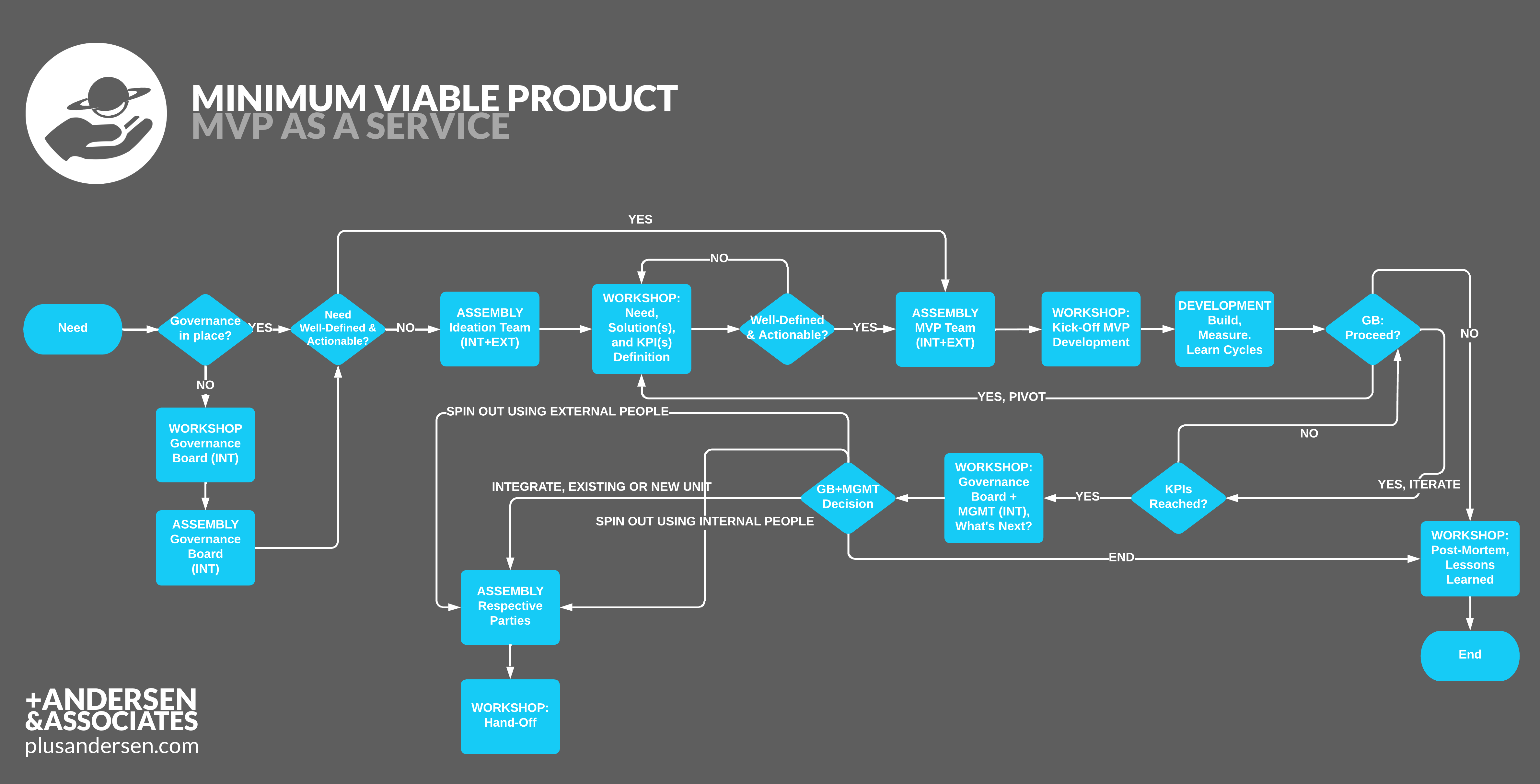
The Prototype as a Service Process
The process is designed to help organizations move from uncertainty to evidence. Each step reduces a different kind of risk: governance risk, problem risk, solution risk, execution risk, market risk, and handover risk.
1. Identify the Business Need
The process starts with a business need, opportunity, or idea - hypotheses to test. Before anything is built, the organization checks whether the right governance structure exists. If there is no clear decision-making structure, a governance workshop is used to define who owns the initiative, who makes which decisions, how progress will be evaluated, and defining the off-ramp options available (with commitment) should the MVP prove successful.
2. Clarify the Problem, Solution Direction, and KPIs
Many innovation projects fail because teams begin building before they know what problem they are solving or what success should look like. This step defines the problem, explores possible solution directions, and translates the initiative into measurable KPIs. The goal is to make the need clear enough that an MVP team can act on it.
3. Assemble the MVP Team
Once the need is actionable, an MVP team is assembled. This team can include internal contributors, external specialists, designers, developers, domain experts, and mediators. The team reports to the governance board, making sure development stays connected to strategic priorities.
4. Build, Measure, and Learn
Development happens through fast iterative cycles. Each cycle produces data that can be tested, measured, or reviewed. The purpose is not simply to build features, but to learn whether the proposed solution creates value and whether the initiative is moving toward its intentions.
5. Decide What Happens After the MVP
When the MVP or prototype has produced enough evidence, the governance board and management decide what happens next, as defined in step 1. The solution may be integrated into an existing business unit, developed further by an internal team, transferred to an operational owner, or spun out into a separate initiative.
6. Capture Learning and Complete the Handover
The process ends with documentation, handover, and a post-mortem workshop. This ensures that the organization captures what was learned, what was validated, what failed, and what should be improved before the next innovation initiative.
How Corporate Decision-Makers Can Use Prototype as a Service
For corporate decision-makers, Prototype as a Service creates a practical bridge between strategy and execution. It helps leadership test whether a business opportunity is worth further investment before committing large budgets, internal teams, or long development cycles.
The model is especially useful when the organization has a strategically important need but lacks clarity about the right solution. By combining governance, KPIs, rapid prototyping, and validation, decision-makers get a clearer basis for go/no-go, pivot, scale, or handover decisions.
- Use it to reduce uncertainty before funding a full product initiative.
- Use it to compare multiple innovation opportunities using evidence.
- Use it to create faster proof points for leadership and stakeholders.
- Use it to avoid over-investing in ideas before the problem and value are validated.
- Use it to create a repeatable process for internal venture building and corporate innovation.
Prototype as a Service Readiness Checklist
Use this checklist to decide whether your organization is ready to move from idea or business need into a managed MVP process.
- Is there a clear business need, customer problem, operational pain point, or strategic opportunity?
- Is there a decision-maker or governance board that can make go/no-go decisions?
- Can the organization define what success should look like before building?
- Are the riskiest assumptions known, or do they need to be discovered?
- Is there access to users, customers, employees, or stakeholders who can provide feedback?
- Can internal and external contributors work together during a short validation cycle?
- Is the organization prepared to pivot, stop, integrate, or scale based on evidence?
- Is there a likely owner (or other off-ramp) for the MVP if validation is successful?
Prototype as a Service FAQ
What does MVP mean?
MVP stands for Minimum Viable Product. It is the smallest useful version of a product, service, or digital solution that can be tested with real users or customers to learn whether the idea creates value and deserves further investment.
What is Prototype or MVP as a Service?
Prototype or MVP as a Service is a managed process for turning a business need, opportunity, or idea into a validated prototype or MVP. It includes governance, problem definition, KPI design, team assembly, iterative development, validation, and handover.
How is Prototype as a Service different from outsourcing development?
Traditional outsourcing usually focuses on building a defined product or feature. Prototype as a Service focuses on reducing uncertainty. It helps define the problem, validate assumptions, measure progress against KPIs, and decide whether the solution should be scaled, changed, stopped, or handed over.
Who should use Prototype as a Service?
It is useful for companies, universities, public agencies, startup support programs, and innovation teams that need to test ideas quickly but lack the internal capacity, team, or structure to build and validate an MVP alone.
Why should corporate decision-makers outsource MVP development?
Corporate decision-makers can outsource MVP development to reduce risk, reduce liabilities, protect internal capacity, sidestep internal resource conflicts, move faster, and create the evidence needed before committing to larger budgets or full product teams. MVP as a Service helps leaders test whether an opportunity deserves further investment before scaling it.
What happens after the MVP is validated?
After validation, the organization decides whether to integrate the solution into an existing unit, create a new internal unit, continue development, transfer ownership, or spin the initiative out using internal or external teams.
Does Prototype as a Service include governance?
Yes. Governance is a core part of the process. If governance is not already in place, the process begins by helping the organization establish a governance board and decision-making structure.
Why are KPIs important in Prototype as a Service?
KPIs make the initiative measurable. They define what success looks like and help the governance board decide whether to continue, pivot, stop, or transition the MVP after each validation cycle.