Defend the core
Growth was mostly about defending existing market position, protecting market share, and incrimentally improving market cap in a relatively stable environment, new market opportunities killed by "we don't do that here".
Corporate Innovation Guide
Innovation does not usually fail because companies do not take innovation seriously. It most often fails because organizations consistently apply the wrong methods, metrics, incentives, people, and structures to the wrong type of work - and then execute like pros on that mismatch to a predictable failure.
TL;DR
In reality, it's of course complex - but generalising, it usually fits in one of these buckets; Corporate innovation fails when companies do the wrong things the right way, the right things the wrong way, or the wrong things the wrong way.
A company can run a disciplined process, assign talented people, create a budget, and still fail if the work is managed with the wrong methods, processes, tools, and KPIs. The Execution tools for business-as-usual are useful for known problems. Other Innovation tools are needed when the company is searching for new business models and new capabilities - the disruptive opportunities of tomorrow that will potentially disrupt their own core of today.
Core Model
Corporate innovation usually fails in one of these ways: doing the wrong things the right way, doing the right things the wrong way, or doing the wrong things the wrong way - and in all cases case failing to simultaneously optimize the core of today AND searching for the new core of tomorrow contributes to expediate the death of great companies.
| Failure pattern | What it means | Typical symptom | Better response |
|---|---|---|---|
| Wrong things, right way | The company executes flawlessly, but on ideas that have not been validated. | Well-managed projects with weak customer demand, poor strategic fit, or little evidence of value. | Validate the problem, customer, value proposition, and business model before scaling execution. |
| Right things, wrong way | The opportunity is promising, but it is managed with the methods for core business only. | "Department Blockers", "Middle Management Meddling". Good ideas are slowed down by planning cycles, internal politics, reporting, wrong processes, wrong tools, and wrong KPIs. | Use customer discovery, Lean LaunchPad, MVP validation, and evidence-based KPIs. |
| Wrong things, wrong way | The company pursues weak ideas and also manages them with the wrong methods. | "Buzzword Bingo" Innovation theater, low-quality prototypes and validation, weak ownership, and no meaningful learning. | Stop, reset governance, clarify the innovation strategy, and rebuild programs around speed & evidence. |
| Either/ Or, not AND | The company prioritises either optimizing execution of the core of today or drops the ball on the core while chasing new opportunities of tomorrow - no clear strategy and means for doing both. | "Carreer Killer", "We don't do that here", "This is not how we do things here", chasing "Shiny Objects". | Work to become an ambidextrous organisation: Companies need to do both Execution AND Search simultaneously to stay successful and resilient for tomorrow today. |
The context changed
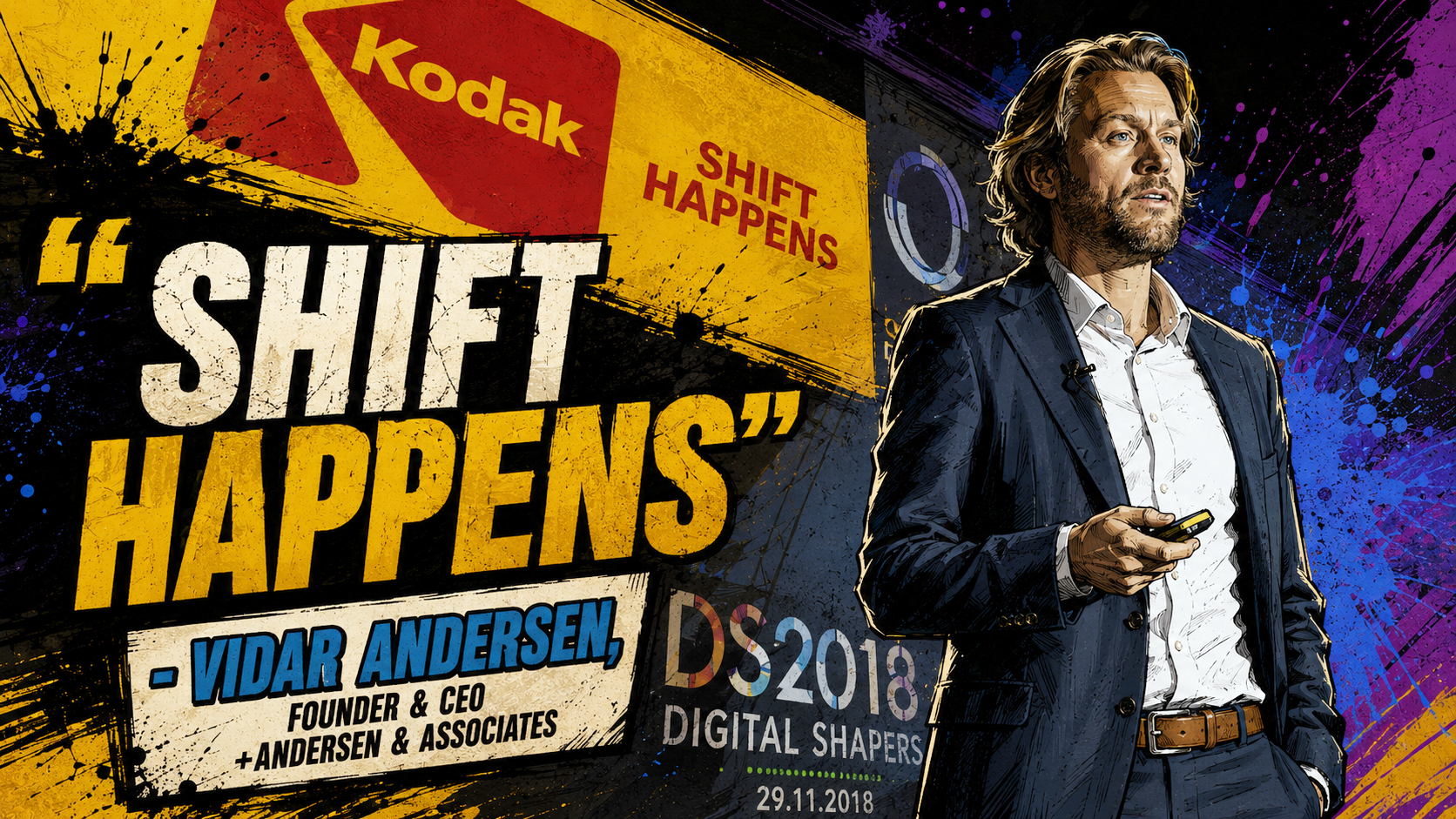
Many companies still manage innovation with assumptions inherited from - and not updated since - the industrial age: stable markets, predictable planning, slow technology cycles, and failure meaning catastrophe. The new game is orders of magnitude faster, much less predictable, more automated, more AI-driven, and completely unforgiving to slow organizations.
Growth was mostly about defending existing market position, protecting market share, and incrimentally improving market cap in a relatively stable environment, new market opportunities killed by "we don't do that here".
Growth increasingly comes from creating and owning new markets before faster, smarter, and more agile competitors do. The new game is mostly about creating new markets at speed in a highly unstable environment - ad infinitum.
Traditionally organizations avoided failure because "we don't do it this way here", didn't know how to fail fast and fail small. Trying new things was also expensive, very slow - and potentially very damaging to your career.
Modern innovation assumes that some new things will fail. The goal is to fail smart, fail fast, building and learning as fast as possible, delivering measurable outcomes with no detrimental effects to businesss or carreers.

The diagnostic
The question is not whether your company is doing things well today. The question is whether you are doing the right things, in the right way, for the right type of innovation - to be prepared for tomorrow today.
The organization uses the right method, governance, metrics, and structure for the specific innovation type. Execution is treated as execution, Search is treated as search - and the organisation is doing both.
The company runs an efficient and professional process, but the process is set up to solve unproven problems or optimizing for output instead of substance.
The company understands that innovation matters, but still tries to manage it with tools, processes, alignment-issues, roles, incentives, and metrics that are antithetical to innovation.
The organization labels activity as innovation at random without clear goals, processes, methodologies, governance, or meaningful metrics.
Outdated tools
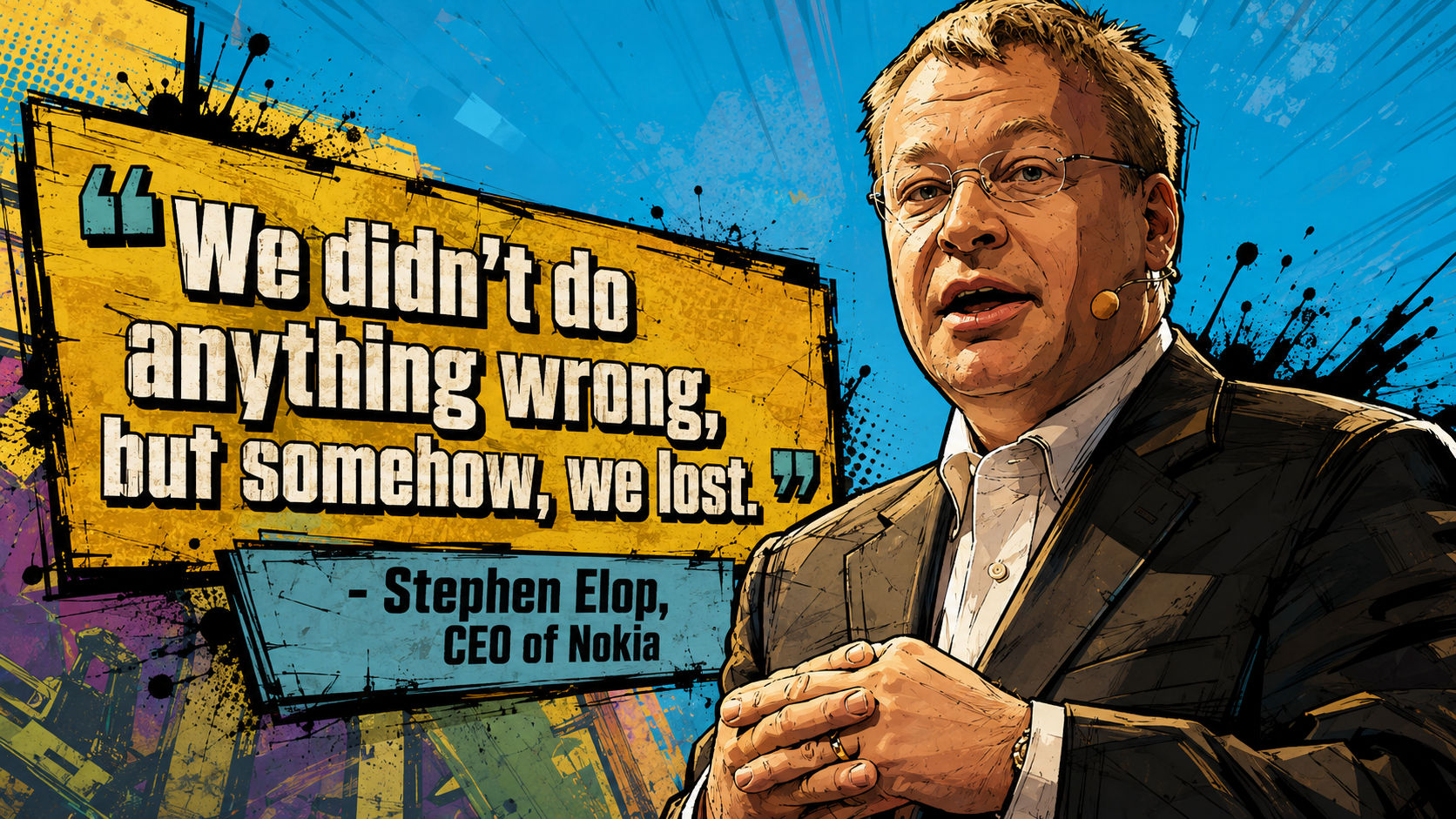
Tools such as traditional growth matrices, forecasting, strategy maps, waterfall project management, rigid org charts, and command-line decision structures were designed for predictability and execution.
Paradoxically, the same tools that helped making the company great become highly dangerous when they are used as the primary operating system for dealing with the uncertainty of searching for new & unproven scalable and repeatable business models.
Many legacy tools assume - falsely - that the future can be planned by extrapolating from what is already known - which is equivalent to magical thinking when dealing with known unknowns and outright negligent when applied to dealing with unknown unknowns.
Heavy up-front planning, long & formal approval cycles, and rigid org charts make the speed of learning and experimentation too slow to actually matter. Before even a single decision has been made, the window of opportunity may have closed.
Most tools for managing the known core today are not relevant for searching for the unknown core of tomorrow. We need other tools, processes, and organisation for gathering direct evidence from customers, users, partners, and markets at speed for effective evidence-based decisions.
Know what kind of innovation you are managing
The Three Horizons metaphor helps corporate leaders distinguish between known work and unknown work. Horizon 1 is about executing and extending the current core. Horizon 2 and Horizon 3 are about searching for new business models, new capabilities, and disruptive opportunities.
The Three Horizons model is widely associated with McKinsey and the work of Mehrdad Baghai, Stephen Coley, and David White. The model remains useful as a taxonomy, but its common time-based interpretation has a critical dangerous flaw: disruptive Horizon 3 ideas are no longer necessarily far off in the future.
| Horizon | What it means | Primary question | Management logic |
|---|---|---|---|
| Horizon 1 | Executing and extending the current core business model. Known knowns. | How do we generate value today and improve what already works? | Execution, product management, operational excellence, business case discipline. |
| Horizon 2 | Extending existing capabilities into new customers, markets, or business model adjacencies. Known unknowns. | What can become tomorrow's growth engine? | Combination of execution and search, experimentation with evidence-based validation. |
| Horizon 3 | Creating new capabilities, disruptive products, or new business models. Unknown unknowns. | What could disrupt our core - and how do we build it before someone else does? | Search, experimentation, customer discovery, rapid learning, and portfolio governance. |
The Update
Changing times require changing models: The Three Horizons model is still useful - but the classic timeframes it suggests are no longer relevant or helpful.
In its updated form, the model should not be used as a simple short-term, medium-term, and long-term timeline. It is more useful as a way to understand strategic distance to your current business model, level of uncertainty, potential impact, required approach, and the right evidence for making decisions.
Learn moreMethodology
Horizon 1 work can use traditional product management because the business model, customers, and operating assumptions are mostly known. Horizon 2 and Horizon 3 work require a search methodology because the most important assumptions are still unknown.
Use scoping, business cases, development gates, testing, validation, and launch processes when the work extends known products, customers, channels, and capabilities.
Use Business Model Generation, customer development, agile engineering, Lean Startup, and Lean LaunchPad when the business model is uncertain.
The goal is not failure for its own sake. The goal is to test hypotheses quickly enough that the organization learns before it overcommits.
Management KPI
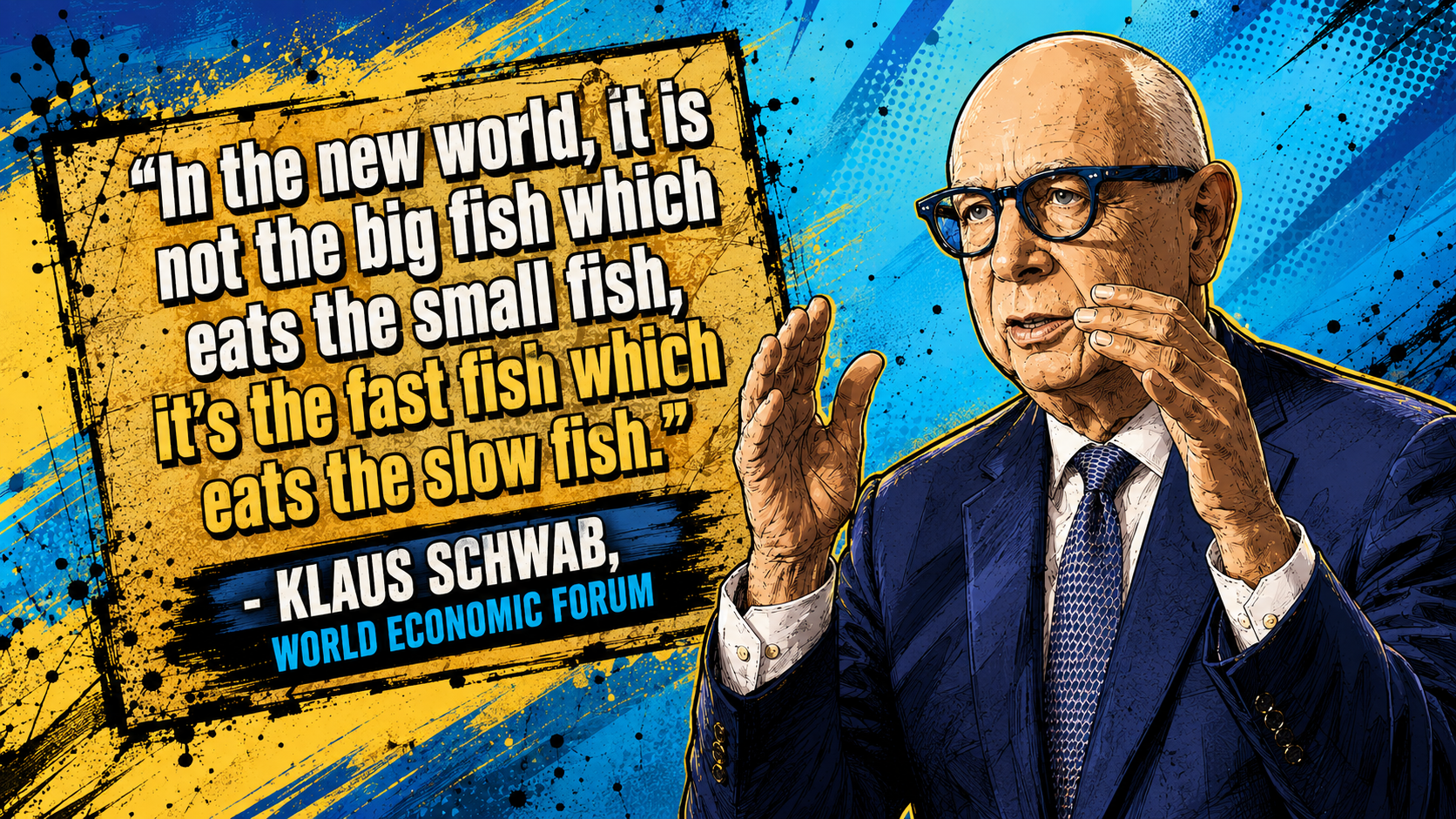
Corporate innovation programs often fail because use throughput, activities, and internal political enthusiasm instead of actual validated learning as guidelines for making decisions. For search work, the metric stack should connect hypotheses, experiments, data, scorecards, and readiness levels.
| Metric layer | What to track | Why it matters |
|---|---|---|
| Hypotheses | Assumptions about customers, problems, value propositions, channels, revenue, partners, and delivery. | Innovation becomes manageable only when assumptions are explicit. |
| Experiments | Customer interviews, MVP tests, landing pages, concierge tests, pilots, pricing tests, and usage experiments. | Experiments turn opinion into evidence. |
| Data | Evidence from real customers, users, partners, stakeholders, and market behavior. | Data creates intellectual honesty. It shows what is true, not what is politically convenient. |
| Experiment scorecard | Weekly progress, learning velocity, evidence strength, and unresolved assumptions. | Scorecards make learning visible to leadership. |
| Investment Readiness Level | Progress from first-pass business model to market validation, MVPs, revenue model validation, value delivery, and metrics that matter. | IRL gives leaders a portfolio-level KPI for innovation maturity and risk reduction. |
Investment Readiness Level - IRL
The evidence-based metric for understanding real progress and risk in innovation.
Investment Readiness Level (IRL) is an evidence-based scale for measuring how ready, how mature a startup, venture, or innovation project is for investment, funding, acceleration, or further support. It helps investors, decision-makers, stake-holders, managers, accelerators, universities, corporate innovation teams, and startup support programs understand how much venture risk has been reduced through customer validation, MVP testing, business model validation, revenue model evidence, and relevant traction metrics.
Learn moreOrganization
Horizon 1 daily operations and Horizon 2/3 disruptive innovation live in different worlds. One protects the core and follows rules. The other must move quickly, test assumptions, and sometimes challenge the core. If both are forced into the same structure, the search work for tomorrow always loses over execution of today - making meaningful change effectively impossible.
Give search teams room to operate outside the routines, incentives, and approval cycles of the core business - out of reach from middle management's business-as-usual interruptions.
Separate the worlds to enable innovation to thrive. Create clear gateways for plannability and transparency. Use governance, legal fast tracks, resource access, portfolio reviews, and handover paths.
Companies need senior innovation ownership, portfolio management, risk management, internal ambassadors who can unblock access to resources, and champions for supporting change accross the organisation.

Problems and solutions
Most innovation failure is not mysterious. It usually follows recognizable organizational patterns. The key is to name the pattern, understand the root cause, and apply the correct fix.
| Failure pattern | Problem | Practical solution |
|---|---|---|
| Shiny objects | Teams become enamored with new technology, abandon the core too early, or treat the existing product team as obsolete. | Do not demoralize the core team. Create a transition plan and make sure money, people, infrastructure, gates and pathways exist to cross from old to new, execution to search to execution. |
| Only "now" | Leadership incentives focus only on current mission, current goals, and current performance. | Create senior innovation ownership, including corporate and divisional innovation leaders who understand Horizon 2 and Horizon 3 work. |
| Buzzword bingo | Innovation becomes a label for everything and anything in the company. | Use the horizons metaphor to define what kind of innovation is being discussed. Use lean and agile methods to accelerate learning, use proven tools like the Lean LaunchPad program to implement and run an evidence-based structure and process. |
| Career killer | Risky projects are avoided because failed projects are politically dangerous and historically expensive. | Make failure part of the process by updating job descriptions, keeping experiments low-cost and fast, rewarding learning, pivots, and evidence. |
| H1/H3 confusion | Daily operations lose sight of whether the goal is to improve what already works or discover something fundamentally new. | Use clear Horizon 1, 2, and 3 language to define the goal, method, metric, people, roles, and governance model for each initiative. |
| No H3 incentives | Divisions and senior roles have no incentives, job descriptions, gates or strategies for supporting disruptive innovation. | Create meaningful incentives, written responsibilities, and integration tactics for Horizon 3 support across operating divisions. |
| No-go top-bottom | Top leadership says "go" and innovators are ready, but middle management kills the program with "no" through sabotage or benign neglect. | Communicate the shared mission, strategy, and tactical implementation. Update job descriptions, expectations, incentives, processes, and support systems for innovation participation. |
| Sales department blocker | Sales blocks access to customers because they fear teams will pitch immature products, damage existing relationships. | Clarify that customer discovery is not selling. It is about understanding user problems, needs, current solutions, and future opportunities. |
| Engineering department blocker | Engineering treats innovation as a technology problem and talks only to familiar experts or a small group of known users. | Focus the organization on customer problems and total available market learning, not only technical feasibility or familiar internal opinions, using evidence-based processes and metrics. |
| Legal department blocker | Legal treats all risks the same, blocking anything remotely risky. | All risks are not equal. Risk is relative and should be treated as such. Set up a clear legal dept fast-track, introduce context-aware, more risk-tolerant policies with transparent decision gates, and clear time-to-decision promise (e.g. within 24h). |
The Lean Launchpad
The world's premier evidence-based support program for early-stage ventures from Stanford.
The Lean LaunchPad program, created by the father of the Lean Startup movement, Steve Blank, at Stanford and UC Berkeley, is a proven, hands-on innovation methodology for turning uncertain ideas into evidence-based business opportunities. Instead of relying on business plans, internal opinions, or stage-gate theater, teams use the Business Model Canvas, customer discovery, rapid experimentation, and weekly evidence reviews to test whether a new venture, product, or business model deserves investment.
Its credibility comes from scale: the National Science Foundation adopted Blank’s Stanford Lean LaunchPad class to create NSF I-Corps, and more than 2,500 NSF I-Corps teams have participated since inception, with nearly 1,400 startups formed and $3.16 billion in subsequent funding raised. The model has also spread across universities, government, science commercialization, healthcare, energy, and defense-related innovation programs, even including GOs like US National Institutes of Health, US Department Of Energy, and the US Department of Defence.
For corporate innovation managers and executives, Lean LaunchPad offers what most innovation portfolios lack: a disciplined way to reduce uncertainty before major spend, expose weak assumptions early, generate customer evidence fast, and focus leadership attention on the opportunities most likely to become scalable businesses. It is idealy suited for organizations that want to move beyond mere idea funnels and workshops toward a repeatable operating system for validated innovatoin and growth.
Learn morePractical tool
Use these questions to quickly test whether your innovation effort is set up the right way for the right goals.
Continued reading
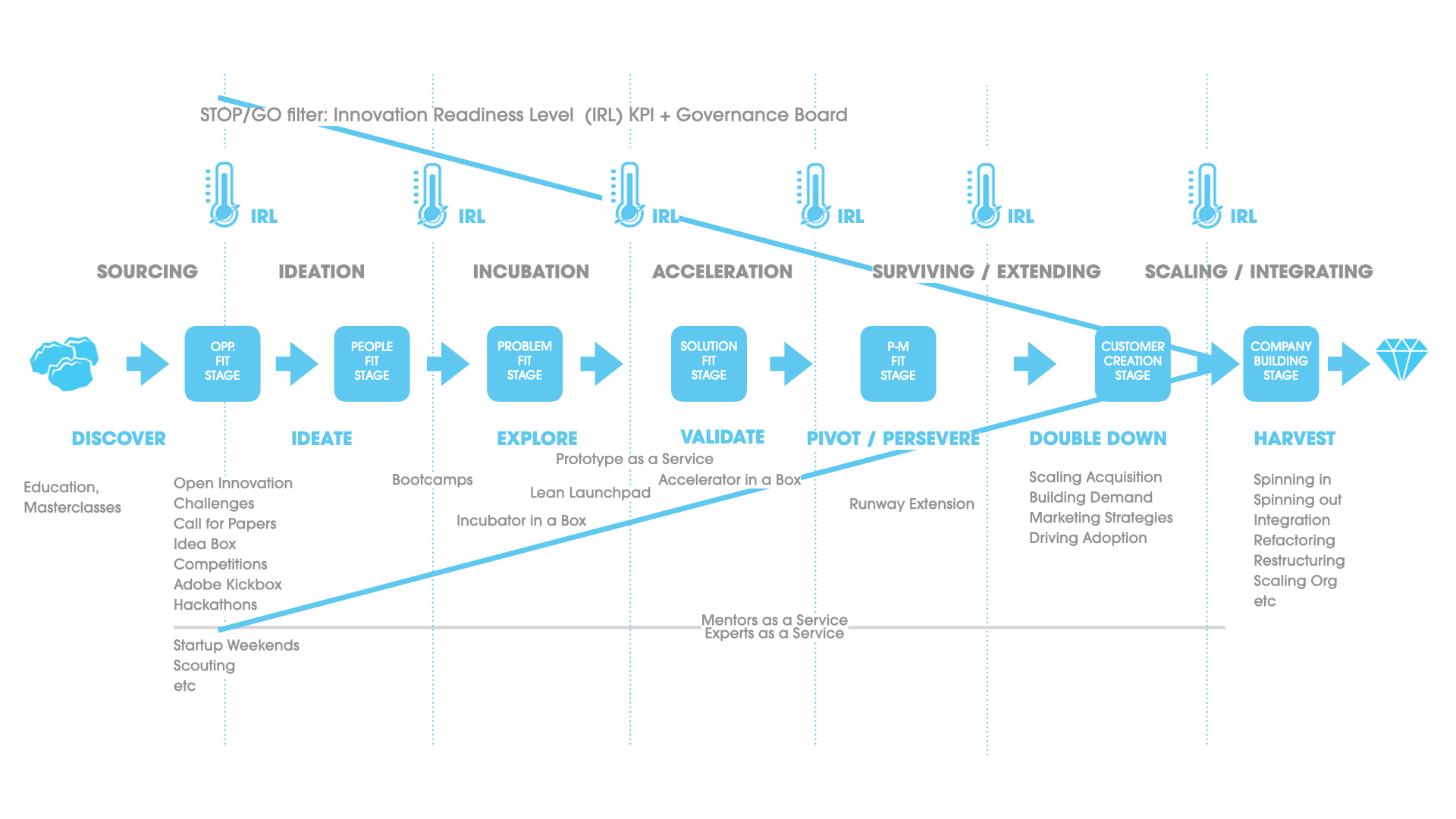
Innovation failure is easier to avoid when program design, processes, frameworks, education, portfolio metrics, and support are all in concert as one functional system; your innovation pipeline.
FAQ
Corporate innovation often fails because organizations do the wrong things the right way, the right things the wrong way, the wrong things the wrong way, or they fail to prioritise both execution AND search for the long-term. The mismatch can be in the methods, tools, metrics, governance, personnel, incentives, or organizational structure.
It means executing efficiently even though the way it is executed in itself is not appropriate for the type of innovation opportunity they are pursuing. A company can execute the process flawlessly and still fail if it applies the wrong execution paradigm to do the job.
Traditional tools often assume predictability, long & linear planning, in a relative stable environment. They can support linear execution, but they were not built for customer discovery and interative non-linear experimentation, effectively offering no solutions to learning at speed.
Companies should use search and validation methods such as Business Model Generation, Customer Development, Agile Engineering, lean innovation, and use proven evidence-based methodologies like the Lean Launchpad. These methods help teams test hypotheses, collect evidence, learn, iterate, and pivot at speed.
Measure according to the innovation type. Horizon 1 can use execution metrics, while Horizon 2 and Horizon 3 need evidence-based metrics such as experiments, validated assumptions, customer discovery progress, and Innovation Readiness Level.
Companies can improve outcomes by matching methods to innovation types, separating search from execution, creating clear governance and gateways, changing incentives, protecting customer access, and measuring evidence instead of activity.
Talk to us
+ANDERSEN & ASSOCIATES helps companies and organisations design better innovation programs, choosing the right methodologies, building evidence-based innovation pipelines, and creating predictable and scalable systems for moving ideas to validated opportunities.
If your innovation efforts are stuck, scattered, or hard to measure, we can help you create more structure and design & execute a better operating model.
Let's talk!