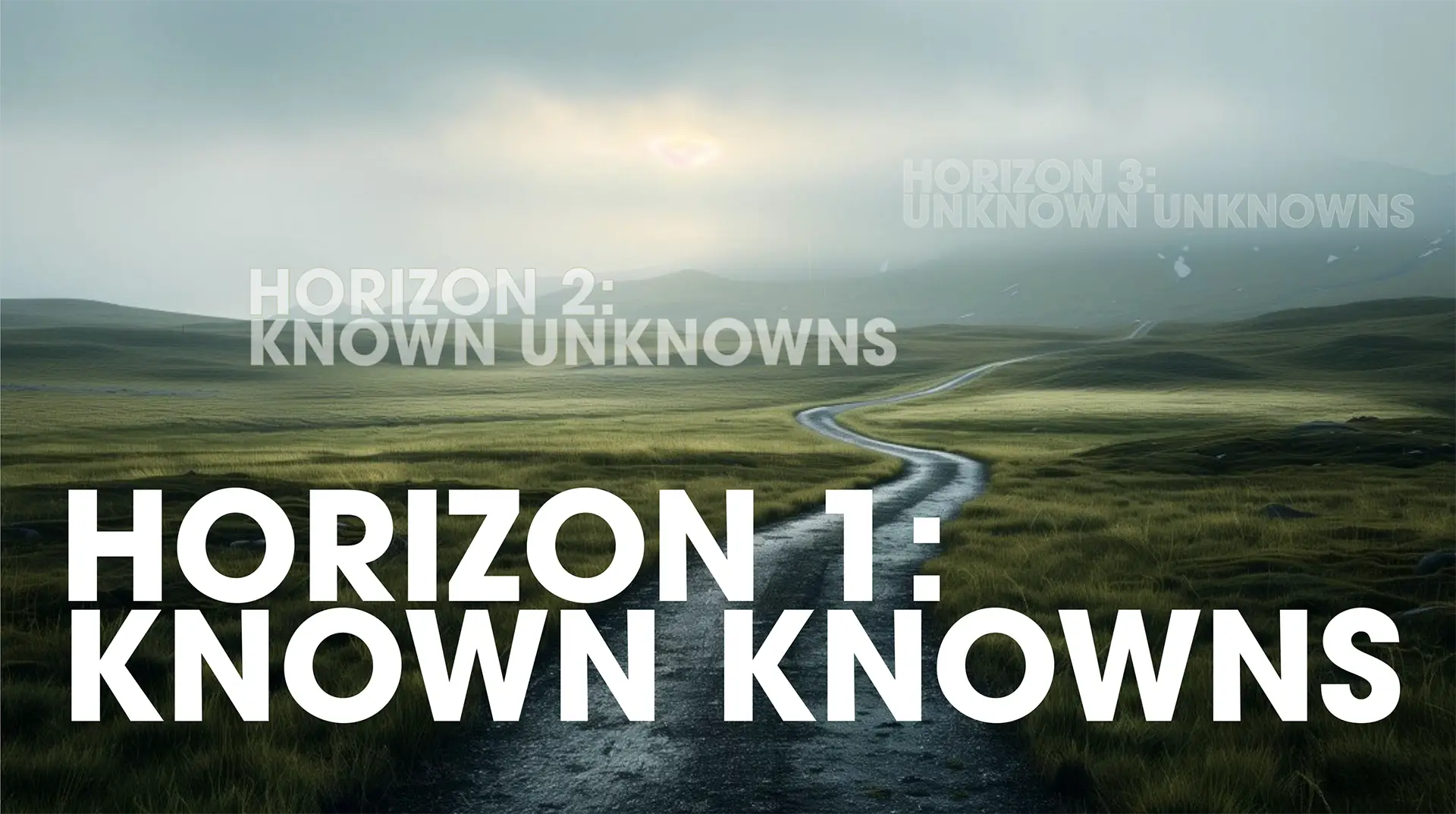
Compare core, adjacent, and transformational initiatives without forcing them into the same business-case logic.
TL;DR
What Is the Three Horizons Model of Innovation?
The Three Horizons Model of Innovation is a corporate innovation portfolio framework that helps leaders separate different types of innovation: improving the current business, extending the business into adjacent opportunities, and creating or responding to transformational opportunities.
In its updated form, the model should not be used as a simple short-term, medium-term, and long-term timeline. It is more useful as a way to understand strategic distance, uncertainty, business model impact, required management approach, and the right evidence for decisions.
The model is widely associated with McKinsey and the work of Mehrdad Baghai, Stephen Coley, and David White. Steve Blank later argued that the model remains useful as a taxonomy, but that its common time-based interpretation has a critical weakness: disruptive Horizon 3 ideas are no longer necessarily far in the future.
Horizon 3 disruption can move quickly. Strategic distance and uncertainty matter more than calendar distance.
Each horizon needs different governance, metrics, methods, funding, and decision cadence.
The update
The Dangerous Flaw:
The Horizons Are Not Timelines
The classic version of the model often treated Horizon 1 as near-term, Horizon 2 as medium-term, and Horizon 3 as long-term. That made sense when new technologies, business models, and channels took years to develop and deploy. It is a dangerous simplification today.
The old interpretation
Horizon 1 was often treated as projects that could deliver quickly, Horizon 2 as projects that would take a few years, and Horizon 3 as distant bets that could safely be explored slowly.
- Useful for portfolio conversations
- Easy for leadership to understand
- But often too comfortable for incumbents
The updated interpretation
The horizons describe how far an initiative is from the current business model, capabilities, customer relationships, operating model, and risk profile — not how many years it will take.
- Horizon 3 can move fast
- Horizon 1 can still be slow
- Speed, evidence, and optionality matter
The practical implication
Corporate decision-makers should stop asking only: “Which horizon is this?” They should also ask: “How fast could this become relevant, what evidence do we need now, and what process, methodology, or vehicle gives us the best chance to learn before competitors or new entrants move?”
The model
Horizon 1, Horizon 2, and Horizon 3 Explained
The three horizons are still useful, but only when each horizon is managed with the right assumptions, methods, metrics, and governance.
Horizon 1: Core Innovation
Horizon 1 focuses on improving, defending, and extending the existing business model. This includes better products, better operations, better customer experience, efficiency improvements, and incremental innovation.
Horizon 2: Adjacent Growth
Horizon 2 extends the organization into new customer groups, markets, channels, offerings, or business model variations while still using some existing capabilities or advantages.
Horizon 3: Transformational Innovation
Horizon 3 explores or responds to disruptive opportunities that may require new capabilities, new partners, new governance, new customer logic, or a new business model. The key update: this does not automatically mean slow.
Decision-making
How Corporate Decision-Makers Can Use the Updated Model
The updated Three Horizons model helps leaders avoid two common mistakes: starving transformational opportunities because they look too uncertain, and overfunding early ideas as if they were predictable projects.
| Horizon 1 | Horizon 2 | Horizon 3 | |
|---|---|---|---|
| What are we deciding? | How to improve or protect the current business. | Which adjacent opportunities deserve validation and scaling. | Which disruptive options deserve fast evidence, protection, or external leverage. |
| What is the main risk? | Execution, adoption, operational complexity. | Market fit, channel fit, business model fit, organizational fit. | Strategic blindness, speed of disruption, business model uncertainty, capability gaps. |
| What evidence matters? | Business case, operational impact, customer impact, margin, adoption. | Customer validation, willingness to pay, channel validation, MVP evidence. | Validated assumptions, learning velocity, option value, strategic fit, speed-to-evidence. |
| What is the right decision cadence? | Quarterly business reviews and operational governance. | Monthly or milestone-based venture reviews. | Fast learning reviews, portfolio option reviews, and strategic trigger reviews. |
For internal innovation champions
The model gives innovation managers, strategy leads, and internal entrepreneurs a language for explaining why different initiatives need different rules, processes, methodologies, and metrics. A Horizon 3 project should not be killed because it lacks Horizon 1 financial metrics. A Horizon 1 project should not be managed like a startup. The value of the model is in making the relevant differences explicit.
Program design
Innovation Program Design by Horizon
Each horizon requires a different kind of innovation program. Trying to use one program format for all three horizons usually creates either innovation theater or corporate friction.
| Useful program formats | Useful methods | Governance design | |
|---|---|---|---|
| Horizon 1 | Continuous improvement programs, internal product sprints, process innovation, customer experience improvement, AI workflow optimization. | Agile delivery, service design, process mapping, operational analytics, customer journey mapping. | Owned by business units with clear operational sponsorship and delivery accountability. |
| Horizon 2 | Corporate accelerator, venture client program, MVP as a Service, startup partnerships, internal venture validation, adjacent market pilots. | Lean LaunchPad, customer discovery, MVP testing, business model validation, Investment Readiness Level. | Joint governance between innovation, business unit sponsors, and decision-makers who can fund next steps. |
| Horizon 3 | Venture building, strategic option portfolio, venture studio, external startup engagement, corporate venture capital, acquisition scouting, deep-tech exploration. | Hypothesis testing, scenario design, ecosystem scanning, rapid prototyping, strategic experiments, option-based funding. | Protected governance with executive sponsorship, fast decision rights, and permission to challenge the current business model. |
Metrics
Different Horizons Need Different Metrics
One of the biggest causes of corporate innovation failure is applying mature-business metrics too early. The updated Three Horizons model helps define what should be measured at each stage of uncertainty.
Horizon 1
- Revenue impact
- Margin improvement
- Cost reduction
- Customer satisfaction
- Operational efficiency
- Adoption and usage
Horizon 2
- Validated customer problems
- MVP engagement
- Willingness to pay
- Channel validation
- Repeat usage
- Investment Readiness Level
Horizon 3
- Learning velocity
- Assumptions tested
- Strategic option value
- Speed to evidence
- Disruption relevance
- Capability gap reduced
Metric rule of thumb
If you know the business and the customer, measure performance. If you are testing an adjacent opportunity, measure validation. If you are exploring transformation, measure learning, optionality, strategic relevance, and speed to evidence.
What changed
As AI Compresses the Horizons
Judgment Becomes Even More Important
Modern AI tools can dramatically reduce the time needed to research, prototype, build, and iterate. But faster product creation does not automatically mean faster customer learning, better strategy, or stronger business models.
Just because you can build it doesn't automatically mean you should. Paradoxically it has never been easier to build new things and it has never been easier to waste time, money, resources, focus, opportunities, goodwill, careers, and LLM tokens on building the wrong things.
What gets faster
- Market and competitor research
- Prototype generation
- Software development
- Landing pages and demos
- Data analysis and interview synthesis
- Alternative solution exploration
What becomes harder
- Separating product output from validated learning
- Avoiding synthetic research instead of real customer contact
- Reading user signals correctly
- Deciding what not to build
- Protecting proprietary data and real moats
- Changing business models when old assumptions expire
The practical update is this: AI makes it easier to produce MVPs, but not easier to know which business should exist. Corporate innovation programs therefore need stronger hypothesis discipline, better customer validation, and clearer decision rules - not just faster prototyping.
Decision tool
Updated Three Horizons Decision Matrix
Use this matrix in portfolio reviews, innovation boards, and program design workshops to decide how an initiative should be governed and funded.
| Horizon 1 | Horizon 2 | Horizon 3 | |
|---|---|---|---|
| Strategic distance | Close to current strategy | Adjacent to current strategy | May challenge or reshape strategy |
| Customer distance | Known customers | New segments or underserved needs | New markets, future customers, or emerging behaviors |
| Capability distance | Existing capabilities | Capability extension | New capabilities, partners, or acquisitions |
| Funding logic | Business case and operational budget | Milestone funding based on validation | Option funding based on evidence and strategic relevance |
| Kill criteria | Does not improve performance or adoption | Cannot validate customer demand or business model | No strategic option value, no evidence progress, or no right-to-win |
Implementation
How to Implement the Updated Three Horizons Model
The updated model is valuable for making critical decisions about innovation today. Use it as a living innovation management and strategy tool.
-
Map all current initiatives
List innovation projects, pilots, startup collaborations, MVPs, internal ventures, and strategic experiments. Place each initiative in a horizon based on strategic distance and uncertainty, not expected delivery date.
-
Identify metric mismatch
Check whether each initiative is being judged by the right evidence. Many Horizon 2 and 3 projects are killed too early because they are evaluated with Horizon 1 metrics.
-
Design or adjust program formats
Choose the right mechanisms: operational improvement for Horizon 1, Lean LaunchPad and MVP validation for Horizon 2, and option-based venture exploration for Horizon 3.
-
Create decision gates
Define what evidence is required to continue, pivot, scale, integrate, partner, acquire, or stop. Make the decision rules visible before teams begin.
-
Review speed and strategic exposure
Ask which Horizon 3 threats or opportunities could move faster than leadership expects. Do not postpone disruptive work simply because it feels unfamiliar.
-
Connect to the right horizon-appropriate program and execution support
Use the right support programs and tools for the right horizon job at the right stages: Use innovation methodology & skills training, bootcamps, Lean Launchpad, and external expertise & capacity for like MVP as a Service, Mentors as a Service, Experts as a Service and program advisory, where internal efforts resources are not available or your internal speed of execution is just too slow.
Related guides and services
Connect the Three Horizons to Your Innovation System
The (updated) Three Horizons model is only useful when applied to innovation strategy, program design, and real-life execution.
Why Innovation Fails
Avoid the common corporate innovation failure traps.
Investment Readiness Level
Use the IRL KPI to measure evidence and venture maturity across your Horizon 2 and Horizon 3 initiatives.
Explore MVP as a Service
Use managed MVP development and validation to move from strategy to evidence without overloading core teams.
Start an Innovation Program
Use our guide to get started with a structured and sustainable approach to internal innovation in your organisation.
AI for everyone
With great capabilities comes great responsibility; Just because it is easier to build stuff with AI than ever doesn't mean you should. So how do we manage this paradox?
Premium Support Structure
The original from Stanford and Berkeley, the leading turn-key program for evidence-based innovation support for your early-stage teams.
Single Components to Full-Service
From consulting & advisory on customising your innovation programs to proven turn-key programs to full-service innovation pipelines - we've got you covered.
FAQ
Three Horizons Model FAQ
What is the Three Horizons Model of Innovation?
The Three Horizons Model of Innovation is a portfolio framework that separates innovation into core business improvement, adjacent growth, and transformational innovation. It helps organizations understand which initiatives need operational execution, which need validation, and which need exploratory or strategic option management.
What is wrong with the traditional Three Horizons model?
The model itself remains useful, but the traditional time-based interpretation is outdated. Horizon 3 should not automatically mean far future. Disruptive opportunities can sometimes be deployed quickly using existing technologies, new business models, AI tools, and external ecosystems.
How should companies use the Three Horizons model today?
Companies should use it to classify initiatives by strategic distance, uncertainty, business model impact, and required management approach. It should guide governance, funding, metrics, program design, and portfolio reviews rather than function as a fixed timeline.
What is Horizon 1 innovation?
Horizon 1 innovation improves, extends, or protects the existing business. It includes operational improvements, product enhancements, customer experience improvements, AI workflow optimization, and other initiatives close to the current business model.
What is Horizon 2 innovation?
Horizon 2 innovation extends the organization into adjacent opportunities such as new customer segments, channels, product categories, or business model variations. It usually requires validation before scaling.
What is Horizon 3 innovation?
Horizon 3 innovation explores or responds to transformational opportunities that may challenge the current business model. The key update is that Horizon 3 is not necessarily slow; it may move quickly when existing technologies are repurposed in new ways.
How does AI change corporate innovation programs?
AI compresses research, prototyping, and product development timelines. This makes it easier to create MVPs, but it also increases the risk of confusing product output with validated learning. Corporate innovation programs need stronger customer validation, better evidence discipline, and clearer decision rules.
From advisory to single program components to managed full-service
Need Help Updating Your Corporate Innovation System?
+Andersen helps corporate decision-makers and internal innovation influencers design practical innovation programs, portfolio logic, metrics, and validation processes that fit today’s speed of disruption.
We can help you translate the updated Three Horizons model into program design, innovation governance, startup engagement, MVP validation, IRL tracking, and decision-making processes that fit your organization.